01The Cave Beneath the Hills
Wind Cave sits beneath the southern Black Hills, accessed near the town of Hot Springs, and ranks among the longest caves in the world — more than 150 miles of surveyed passage, with surveyors confident the known system represents only a fraction of what remains. The name comes from the entrance's tendency to exhale or inhale air as atmospheric pressure shifts, a phenomenon the Lakota recognized long before European settlers reached the region.
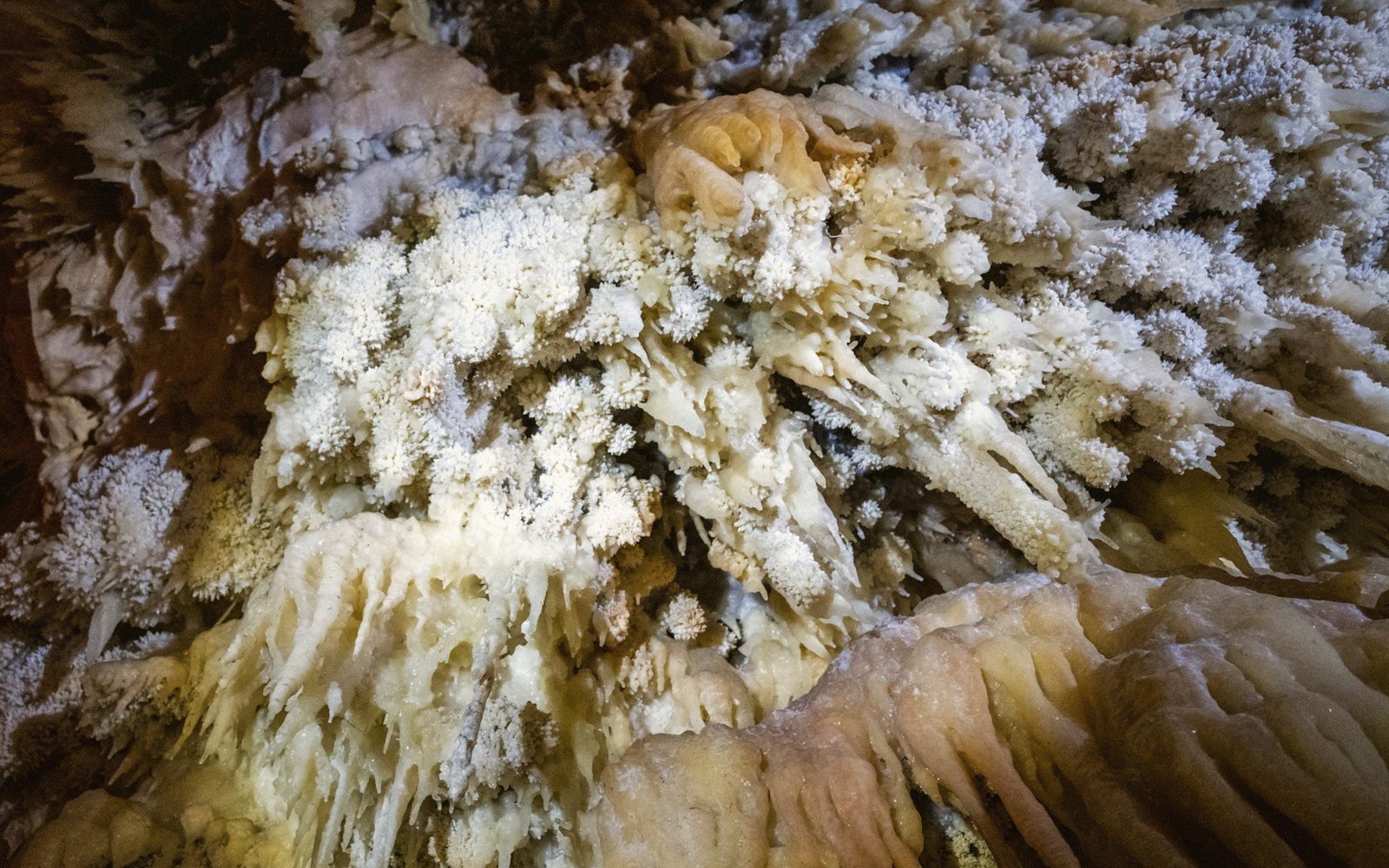
What makes Wind Cave scientifically significant is boxwork — a formation of thin calcite fins projecting from cave walls and ceilings in a honeycomb grid. Wind Cave contains the most abundant and best-developed boxwork on Earth. The fins are remnants of calcite that filled fractures in the host limestone; when slightly acidic groundwater dissolved the surrounding rock away, the harder calcite stayed behind, leaving the latticed structure standing proud of the wall. Individual boxes range from thumbnail-sized to several inches across, and in some passages the ceilings are entirely tiled with the formation. Elsewhere in the cave, other rare formations — cave popcorn, frostwork, and moonmilk — appear, but it is the boxwork that draws geologists.
The cave is administered by Wind Cave National Park, which also protects a substantial block of mixed-grass prairie above ground. Bison, pronghorn, and elk move through the surface park; coyotes work the prairie edges at dusk. The two environments — subterranean maze and open grassland — share the same ground, layered one above the other.
Elevations, ages and distances here are approximate and given as published. Ground conditions change; the terrain descriptions do not.
02Ground named in this piece
Wind Cave National Park
The Black Hills
national park in the southern Black Hills protecting the cave and surrounding mixed-grass prairie
Hot Springs
The Black Hills
town near the Wind Cave National Park entrance